

About the Author
Albertus Roux is a sports scientist and ultra-trail runner specialising in endurance performance and human physiology. Drawing on scientific research, coaching experience, and years of ultra-distance mountain running, his work focuses on resilience, discipline, and the mental and physical demands of endurance sport. He helps athletes improve performance and unlock long-term potential through evidence-based insight and real-world experience.
There’s always a push in longevity research to identify plant compounds that offer health benefits. Some of the better-known examples are polyphenols in cherries and red wine. Early promising findings drive the isolation and commercialisation of these compounds. Nine times out of ten, these compounds aim to reduce oxidative stress and protect against cancer, with the study of oxidative stress usually carrying over into exercise science. In this blog, we uncover the story behind the new craze in the endurance space: Nomio (broccoli sprouts).
Good Stress vs Too Much Stress
Exercise is a controlled dose of oxidative stress. The body responds by upregulating its defence systems, primarily through the Nrf2 pathway, which activates antioxidant genes. This is one way training stress causes adaptation. Blocking the Nrf2 pathway in animal studies leads to a loss of muscle function and exercise performance. Interestingly, giving athletes direct antioxidants like vitamin C or E can blunt training adaptations, because it interferes with the natural signalling processes. In simple terms, this is hormesis (what doesn’t kill you makes you stronger).
But there’s a tipping point: overtraining causes Nrf2 signalling to lag behind oxidative stress. Oxidative markers overwhelm the body, mitochondrial function suffers, and sickness often follows. Flockhart et al. (2023) put it well: “a cellular environment subtly skewed towards pro-oxidant conditions may be associated with improved adaptations to exercise training.”
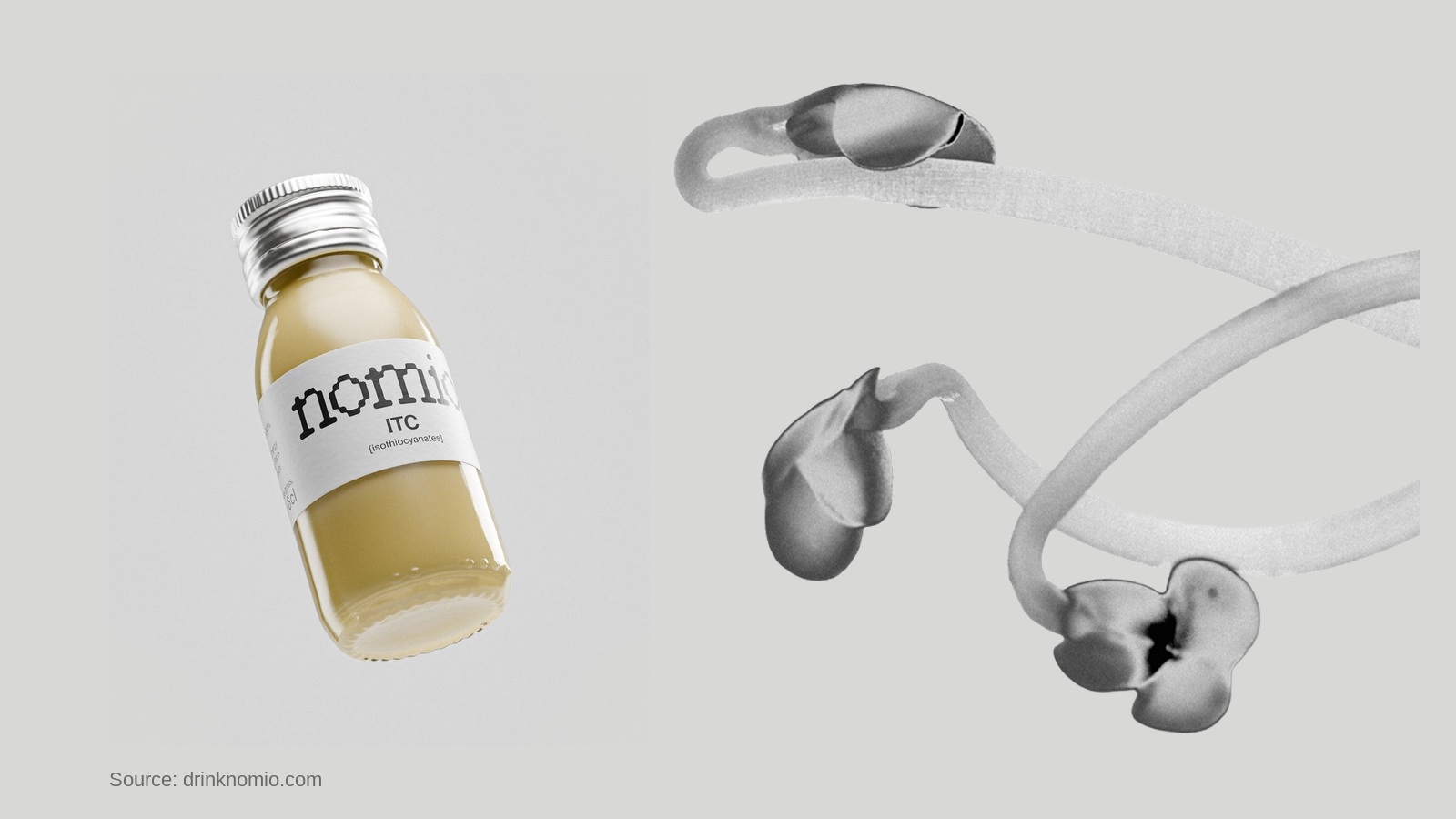
Broccoli sprouts are rich in glucosinolates, which can convert into isothiocyanates, most notably sulforaphane. This only happens once the sprouts are chewed or blended and with help from an external enzyme called myrosinase. Sulforaphane is one of the more potent natural activators of the Nrf2 pathway. One blended extract product you may have seen is Nomio, a proprietary blend of broccoli sprout extract (glucosinolates/isothiocyanates), lemon juice, and sugar.
The Study: Broccoli Sprouts vs a Week of HIIT
Flockhart et al. (2023) had nine healthy participants complete seven consecutive days of high-intensity interval training while drinking either a glucosinolate-rich broccoli sprout drink (GRS) or a placebo (alfalfa sprout) drink twice a day in a randomised, blinded, crossover design. This means each participant completed both conditions at different times.
Here’s what a week of broccoli sprouts alongside intense training did, compared to placebo:
- Less oxidative damage in muscle. Carbonylated protein content (a marker of oxidative damage) was elevated in placebo but decreased in the GRS group.
- Less inflammation. Myeloperoxidase, a marker released by immune cells during inflammation, was elevated with placebo and decreased with GRS.
- Nrf2 activation. Muscle Nrf2 protein increased significantly after training only in the GRS condition.
- Lower lactate at the same submaximal effort. Work rate at a fixed blood lactate concentration improved by roughly 15–20 watts (about 15%) with GRS, despite no measurable change in VO2max or mitochondrial capacity.
- Improved time to exhaustion. Participants in the GRS condition improved their time to fatigue during a maximal test; the placebo group did not.
- Less nocturnal hypoglycaemia. Using continuous glucose monitors, the placebo group spent an average of 5 hours 21 minutes per day with glucose below 4 mmol/L. The GRS group spent just 2 hours 16 minutes, less than half.
To be clear, this was a small study with only nine subjects, and several outcomes were near-significant rather than clearly significant. But the consistency of the direction across markers of oxidative stress, inflammation, performance and glucose control makes it compelling.
Why This Matters for Trail Runners
If you’ve ever done a big training week and found yourself waking up shaky and starving at 3 am, this study offers a plausible physiological explanation that goes beyond “you didn’t eat enough carbs.” Oxidative stress from repeated training exposure appears to disturb glucose regulation independently of energy balance. Broccoli sprout products may offer some protection against this nocturnal hypoglycaemia.
The researchers aren’t entirely sure why lactate dropped without any change in mitochondrial function. Still, they suspect it may relate to a shift toward using more fat as fuel or to an increase in the body’s conversion of lactate back into glucose (gluconeogenesis). Either way, lower lactate at a given effort is the kind of adaptation every trail runner wants.
My Takeaway
In research, always read between the lines. I have a few problems with the claims that Nomio have on its website. Phrases such as “clinically backed”, “reduces lactate”, and “eases soreness post-exercise” can be misleading if not read in context. First, the research group studying broccoli sprout extracts and related compounds is closely linked to Nomio, creating a potential conflict of interest.
Secondly, many of the stronger claims lean on studies in lab rats and in vitro muscle cells. Currently, there is only one peer-reviewed study in humans. That study, as mentioned above, had nine non-athlete participants; therefore, it cannot be considered rigorous enough to justify the hype. I’m not saying there isn’t promise for this supplement. I am saying athletes should think before they buy into the marketing.
If this is an avenue you want to explore, my best advice would be to keep it simple:
- Grow your own or buy fresh sprouts. The isothiocyanate conversion depends on the enzyme myrosinase, which means the sprouts need to be chewed or blended raw. Cooking destroys much of this enzyme activity.
- Pair sprouts with a mustard seed powder or another myrosinase source if you’re juicing or blending them. This may help drive the conversion of glucosinolates to isothiocyanates, as the study did using brown mustard seed powder.
- Time it around your hardest weeks, not necessarily year-round. This was tested specifically during a period of deliberately excessive load.
- Watch your overnight numbers if you use a CGM. Recurrent nocturnal lows during a big block may be a sign your recovery capacity, not just your carb intake, needs attention.
What I like about this study is that it doesn’t try to sell antioxidants as a shortcut. In fact, it reinforces something we already know: dumping in a big dose of vitamin C or E can blunt your training response. Broccoli sprouts appear to work differently, boosting your own Nrf2 defence system, rather than dealing with oxidative stress directly. That’s why this is worth watching rather than dismissing as another supplement fad.
Reference
Flockhart, M., Nilsson, L.C., Tillqvist, E.N., Vinge, F., Millbert, F., Lännerström, J., Nilsson, P.H., Samyn, D., Apró, W., Sundqvist, M.L. & Larsen, F.J. 2023. Glucosinolate-rich broccoli sprouts protect against oxidative stress and improve adaptations to intense exercise training. Redox Biology, 67, 102873.
FAQs
Q1: What are broccoli sprouts and how do they help runners?
Broccoli sprouts are rich in glucosinolates, compounds that convert into isothiocyanates (like sulforaphane) when chewed or blended. These activate the body’s own Nrf2 antioxidant pathway, which appears to help manage the oxidative stress of hard training rather than simply blocking it.
Q2: Should I take antioxidant supplements like vitamin C during heavy training?
Research suggests high-dose direct antioxidants like vitamin C and E can interfere with some of the training adaptations you are trying to build. Broccoli sprouts work through a different, indirect pathway, and this study did not show the same blunting effect.
Q3: Can broccoli sprouts help with nighttime blood sugar crashes during hard training blocks?
In this study, participants using continuous glucose monitors spent less than half as much time in hypoglycaemia overnight when supplementing with broccoli sprouts compared to placebo, during the same week of intense training.
Q4: Do broccoli sprouts improve running performance?
In this small study, participants who supplemented with broccoli sprouts showed lower lactate at a given work rate and improved time to exhaustion compared with placebo, while VO2max and mitochondrial function were unchanged; thus, the exact mechanism remains unclear.
Q5: How should I prepare broccoli sprouts to get the benefit?
Sprouts need to be chewed or mechanically processed, such as by blending, to activate myrosinase. This enzyme helps convert glucosinolates into active isothiocyanates. Some protocols add mustard seed powder to boost this conversion.