


About the Author
Albertus Roux is a sports scientist and ultra-trail runner specialising in endurance performance and human physiology. Drawing on scientific research, coaching experience, and years of ultra-distance mountain running, his work focuses on resilience, discipline, and the mental and physical demands of endurance sport. He helps athletes improve performance and unlock long-term potential through evidence-based insight and real-world experience.
Part 2: How we studied it, and what actually matters
This is Part 2 of a 3-part series based on my Honours dissertation:
A multivariate model predicting ultra-trail running performance.
Who this article is for
This article is for trail runners and coaches who want to understand what actually influences ultra-trail performance, beyond genetics, talent, or lab-based testing. If you’ve ever wondered where to focus your training time and energy, this is for you.
From curiosity to research
I grew up participating in almost every sport I could, searching for the one thing I was “good” at. I was never the most physiologically gifted athlete in the room. What I did have was a deep curiosity about how far I could push my limits with the hand I was dealt.
From long days in the pool during my swimming years, to self-imposed weekend suffer-fest training camps, I eventually found my way to ultra-distance running. What fascinated me wasn’t instant success, but the slow, steady expansion of what my body could tolerate and adapt to over time.
Along the way, I learned something important. Success in endurance sport is rarely reserved for those born with exceptional physiology. More often, it belongs to those who can tolerate discomfort over long periods of uncertainty. And success is best measured against your previous self, not against others.
This dissertation grew from that idea. When an event is long, unpredictable, and unforgiving, what qualities actually matter for ultra-trail running performance?
A quick recap from part 1
In Part 1 of this series, we explored why ultra-trail running performance is so difficult to predict and why the classic endurance model only tells part of the story.
We ended with a key question:
If VO2max, running economy, and lactate threshold explain only about 50 percent of ultra-trail performance, what makes up the rest?
To answer that, we need to look at how the study was designed, what was measured, and what the data revealed.
Who did we study?
We analysed data from 19 amateur male trail runners who completed the 2024 Ultra Trail Cape Town 100 km.
These were not professional athletes. They were everyday runners balancing training with work, family, stress, and life commitments. That matters, because ultra-trail performance does not happen in a vacuum. It happens in the real world.
What variables were measured?
Rather than focusing on a single aspect of performance, we measured variables that reflect three key areas:
- The athlete’s physiological engine
- Their training history
- Their real-world performance
These variables were grouped into two main categories.
Physiological variables (The engine)
Laboratory-based testing included:
- Submaximal running economy at different gradients and speeds
- Maximal oxygen uptake (VO2max)
- Anthropometry (height, body mass, body composition)
These represent the traditional physiological measures often used in endurance research.
Non-Physiological variables (What the engine does)
Training data from Strava covering the 12, 6, and 4 months prior to the race:
- Total distance, time, and elevation gain (training volume)
- Distance-to-elevation ratio (training characteristics)
- Average running speed (training intensity)
- Mean monthly distance, time, and elevation gain (consistency)
Real-world performance markers, collected via survey and validated through Strava:
- Personal best times over 5 km, 10 km, half marathon, marathon, and 50 km
- Number of injuries in the 12 months before the race
- Average number of strength training sessions per week
This was a retrospective study, meaning we analysed existing data. The work built on a parent study by Simon J. de Waal and Shaundre D. Jacobs, combining laboratory testing with real-world training and performance data.
How was performance defined?
Performance was defined as race completion time in the 2024 UTCT100.
In ultra-trail running, finish time is a robust global performance metric. It captures not only fitness but also the ability to manage terrain, fatigue, nutrition, pacing, and mental resilience throughout the race.
For the data-inclined readers
If statistics are not your thing, feel free to skip this section. The practical takeaways follow immediately after.
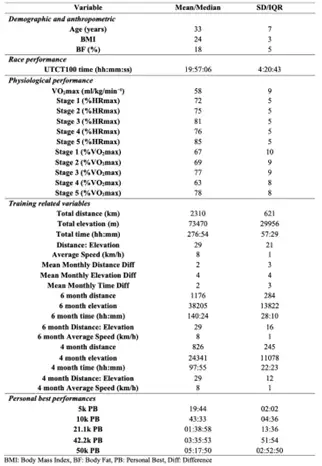
Table 1: Descriptive statistics of participants
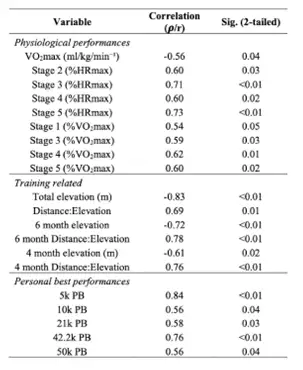
Table 2: Bivariate correlations with race time
Table 1 presents descriptive statistics for the participants, showing average values (means or medians) and variability (standard deviations or interquartile ranges). This gives context for what the “average” UTCT100 finisher in this group looked like.
Table 2 presents bivariate correlations between each variable and race time. The nearer the correlation value is to 1, the stronger the relationship between the two variables. The nearer the significance value is to 0, the greater our confidence that this relationship is not due to chance. Importantly, correlation does not imply causation.
Key Predictive Variables
The variables with the strongest and most significant relationships to race time were:
- 5 km personal best
- Total elevation gain in the 12 months before the race
- Marathon personal best
- Running economy at a 25% gradient
- Running economy at a 10% gradient
- Distance-to-elevation ratio
These findings support previous research showing that non-physiological variables are more strongly associated with ultra-trail performance than traditional lab-based metrics alone.
Creating a model with real-world variables likely explains ultra-trail running performance better than the classic endurance model alone, potentially accounting for the remaining 50% of variance in what makes a great ultra-trail runner.
Modelling Ultra-Trail Performance
To understand which combination of variables best explained performance, we built predictive models.
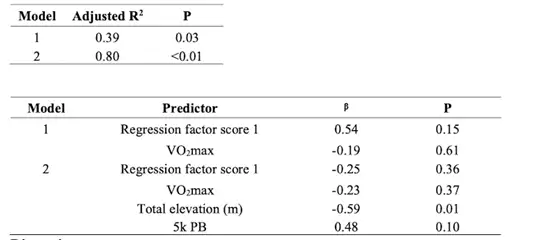
Table 3+4: Different models of performance
First, we tested a model using only the strongest physiological variables: running economy (Regression factor score 1) and VO2max. This model explained approximately 40% of performance, aligning with earlier findings that physiology accounts for roughly half of trail running outcomes.
Next, we added the strongest non-physiological variables: total elevation gain and 5 km personal best into the previous model. The explanatory power increased dramatically to 80 percent.
In practical terms, this shifted the model from a rough estimate to something closely explaining what actually happened on race day.
In table 4 we see the strength of each variable within the model (ᵝ), showing that total elevation gain and 5 km personal best had roughly double the predictive influence of VO2max and running economy. This reinforces a key conclusion: ultra-trail running performance is not just about physiology.
The training that you do, as well as real world performance tests such as a 5k personal best adds significant value to explaining performance.
Key Takeaways from the model
- Physiological capacity still matters, but it is not the dominant factor
- Real-world training variables explain far more performance variance
- Simple performance markers can outperform complex lab testing
- Ultra-trail running demands specificity beyond traditional endurance models
What this means for runners and coaches
Physiology still matters, but it’s not king
Classic endurance metrics form part of the foundation, but they do not define ultra-trail success. Over long, technical, mountainous terrain, other factors play a much larger role.
Relying heavily on VO2max or lactate threshold testing can be misleading for trail athletes. Instead, repeatable field-based tests such as 5 km or 30-minute time trials, and standard trail routes, offer more practical insight into performance progression.
These factor in pacing, motivation, trail specific skills, and mental toughness which are honed over time. Bottom line, simplify your testing and markers of performance, you don’t always have to go to a lab.
Prioritise elevation gain and loss
Total elevation gain in the year leading up to the race emerged as one of the strongest predictors of performance.
This aligns with the S.A.I.D. principle (specific adaptations to imposed demands). The UTCT100 includes nearly 5,000 metres of climbing on steep terrain. To perform well, athletes must train both the climbs and the descents.
Then the assumption can be made that you need to run down what you run up. The more you train the skill of uphill and downhill running the better you become, simple as that. You need to have specific adaptations to run up and down effectively, these include but are not limited to:
- Aerobic efficiency for sustained climbing
- Downhill confidence and control
- Proprioception and ankle stability
- Concentric strength for uphill running
- Eccentric strength to manage downhill muscle load
- Mental resilience for prolonged effort
These adaptations are built through consistent, specific training.
Track and use personal bests over time
Monitoring performance over time provides a valuable snapshot of current fitness and training effectiveness. In this study, the 5 km personal best offered the strongest insight into UTCT100 performance when combined with trail-specific training variables.
A fast 5 km alone does not guarantee ultra-trail success. It is when in combination with a trail specific training variable such as total elevation gain when it becomes valuable. Using a repeatable trail route near you as a benchmark can provide even better insight into trail-specific fitness.
What’s coming in Part 3
In the final part of this series, we move from research to application:
- How coaches can apply these insights
- What this means for training structure
- How to prioritise testing and monitoring
- Where athletes should focus their time and energy
Because research only matters if it helps you run better on race day.
FAQs
What factors most influence ultra-trail running performance?
Ultra-trail running performance is influenced by a combination of physiological capacity, training volume, elevation exposure, and real-world performance markers, with non-physiological variables playing a larger role than traditional lab metrics.
Why does elevation gain matter so much in ultra-trail running?
Elevation gain reflects the specific demands of trail racing. Training for sustained climbing and descending builds muscular, metabolic, and technical adaptations that strongly influence race performance.
Is VO2max important for ultra-trail running?
VO2max contributes to ultra-trail performance but explains far less variance than in road running. It should be viewed as a foundation rather than a primary predictor of success.
Why are personal best times useful for trail runners?
Personal best times reflect training adaptations over time and capture pacing, motivation, and resilience. When combined with trail-specific training data, they provide valuable insight into performance potential.
Can ultra-trail performance be predicted accurately?
While no model can predict ultra-trail performance perfectly, combining physiological, training, and performance variables can explain a large portion of race outcomes and guide more effective preparation.