

About the Author
Albertus Roux is a sports scientist and ultra-trail runner specialising in endurance performance and human physiology. Drawing on scientific research, coaching experience, and years of ultra-distance mountain running, his work focuses on resilience, discipline, and the mental and physical demands of endurance sport. He helps athletes improve performance and unlock long-term potential through evidence-based insight and real-world experience.
If you’re a seasoned endurance athlete you’ve probably attributed at least one failed race experience to “blowing up because I went into lactate”, as if lactate itself were the thing sabotaging you. One of the most persistent myths in endurance sport is that lactate is a toxic waste product that builds up until it forces you to slow down.
Not only is it wrong, it’s completely backwards. Lactate is one of your body’s favourite fuels, a signalling molecule, and quite possibly the reason your brain and heart keep functioning deep into an ultramarathon. Understanding lactate changes how you pace races, structure training blocks, fuel hard sessions, and interpret threshold workouts.
This week we’re unpacking the real science of lactate, and looking at why some of the world’s best cyclists are now deliberately drinking lactate mid-race at the Tour de France.
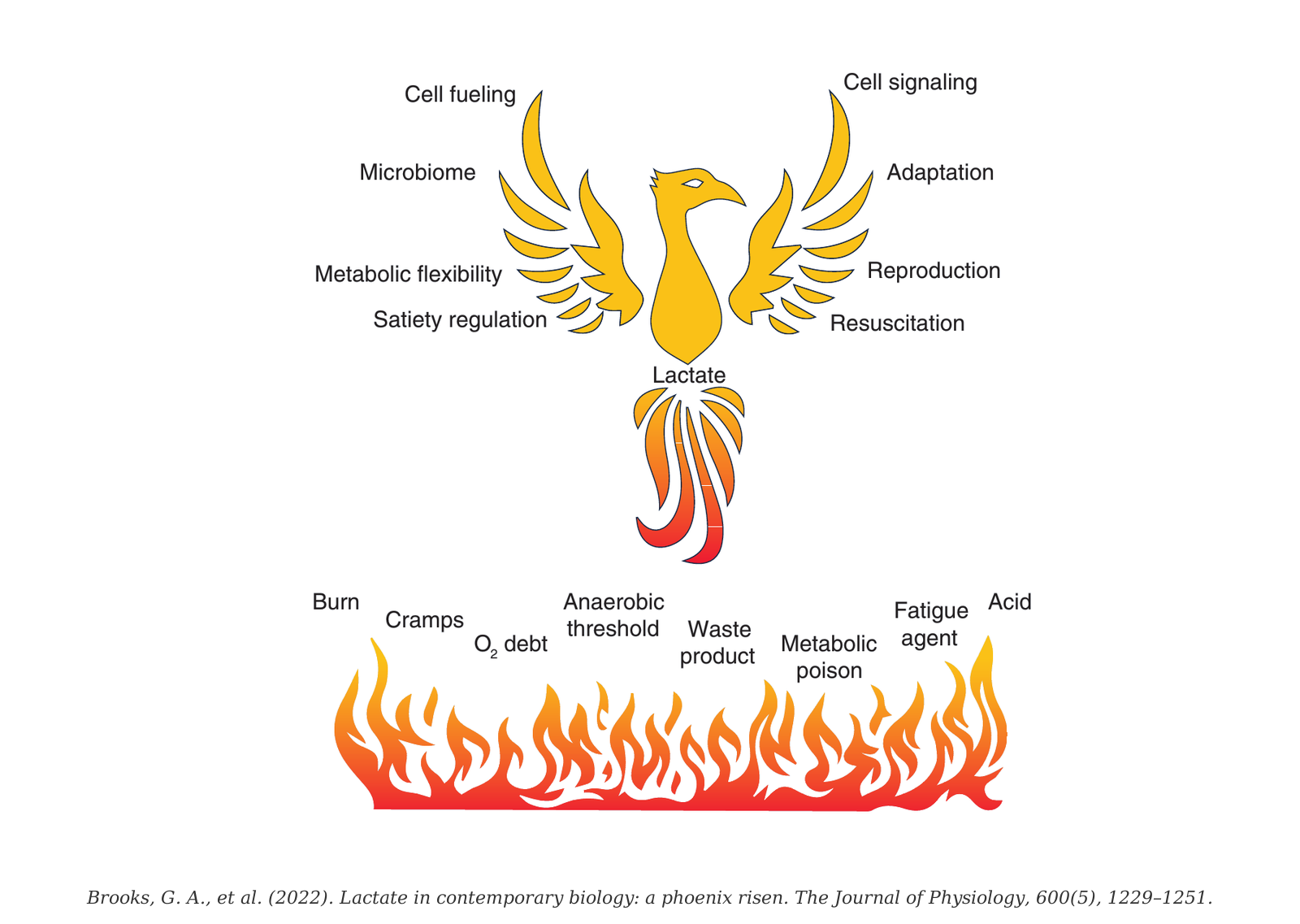
Lactate: A Phoenix Risen
For most of the 20th century, lactate had a bad reputation. Early researchers wrongly concluded that muscles produced lactate because they were running low on oxygen, caused by the heart failing to deliver enough oxygenated blood (the Wasserman theory). Lactate’s buildup caused the burning sensation, the cramping, and eventually the fatigue that ends a hard effort. Textbooks called lactate a “metabolic poison” and a “waste product.” That idea is now considered outdated by exercise physiologists, replaced by a much richer picture of lactate as a central, actively used fuel in the body, produced constantly, even at rest and even when oxygen is abundant.
In their fantastical paper Brooks et al. (2022) stated “Like a Phoenix, lactate has risen to major importance in 21st century biology.”
The key insight is something called the lactate shuttle. Lactate produced in one cell doesn’t just remain there, it gets shuttled out into the bloodstream and taken up by other cells that are hungry for fuel: your heart, your brain, neighbouring muscle fibres, even your liver, which can convert it back into glucose. Lactate is described as sitting at the “fulcrum” of your metabolism, a currency that shuttles energy from where it’s being produced to where it’s needed.
- Your heart runs on it. Working muscles releases lactate that fuels the heart, particularly during exercise, when the heart’s demand for fuel goes up.
- Your brain prefers it. Lactate crosses the blood-brain barrier and can fuel neurons directly, and there’s evidence it plays a role in memory formation and cognitive function, which is part of why lactate has even been trialled as a treatment after traumatic brain injury.
- It regulates fat burning. Lactate suppresses fat breakdown by binding to a receptor called HCAR-1, part of how your body decides which fuel to prioritise during exercise.
- It’s mostly made under fully oxygenated conditions. This is the part that really disproves the old theory, lactate production ramps up during exercise not because your muscles are short of oxygen, but because it’s a fast, efficient way to keep glycolysis running and shuttle energy to where it’s needed.
In medicine, lactate is a key warning marker in critical illness, but it may also be therapeutic. In traumatic brain injury research, exogenous lactate infusion is being investigated as a way to support brain metabolism when the injured brain struggles to use glucose efficiently. In cardiology, lactate is also being reinterpreted as a fuel and signalling molecule rather than only a sign of hypoxia, with emerging interest in continuous lactate monitoring.
None of this means lactate accumulation feels good, or that “going into the red” is free. High blood lactate is still a marker of hard effort, and the muscular fatigue you feel late into a race is real. But the fatigue isn’t lactate poisoning you. It’s a far more complicated mix of acidosis, fuel depletion, and central nervous system fatigue, and lactate itself is more often part of the solution rather than the cause.
The Kilian Jornet data point
Álvarez-Herms and Jornet (2024) gives us a real-world illustration of lactate kinetics during an Ultramarathon. It shows Kilian Jornet’s physiological data during his 2022 UTMB win (172km, 10 000m of vert). His blood lactate rose from 0.8 mmol/L before the race to 13 mmol/L after finishing, roughly 20 hours later, alongside a big rise in triglycerides and ketones. It was never considered that you would get to a lactate of 13 mmol/L in an event as long as this, we would see values like this at maximal effort. But rather than lactate grinding him to a halt, his data points to his exceptional metabolic flexibility: fat oxidation ramping up progressively through the second half of the race while glycolysis, and lactate production, stayed active right through to the finish. His body wasn’t avoiding lactate production. By using multiple fuel systems simultaneously, lactate included, he was able to stay competitive for 20 hours in the mountains.
This finding and others recently flipped the script on what’s known about substrate usage during an ultramarathon. The body isn’t just using proportions of fats and carbohydrates, it draws from as many sources as possible, with lactate being very energy dense and efficient. Maybe metabolic flexibility can be a proxy for ultra-trail running performance?
Enter the lactate gel
This brings us to one of the most interesting developments in sports nutrition. Exercise physiologists have known for years that lactate is a usable fuel, but there was a practical problem: delivery. If you tried to feed athletes meaningful amounts of lactate, it caused gastrointestinal distress before you could absorb the minimal dosage.
That code appears to have been cracked this year, and it’s playing out at the 2026 Tour de France. Reports from the race describe a new generation of exogenous lactate products. UAE Team Emirates-XRG, working with their nutrition partner Enervit and physiologists including George Brooks (the researcher behind the paper talked about here), have been using a product called the C2:1PRO Lactate Gel Mix on selected high-demand stages. It’s a bottle-mixed drink containing around 10g of sodium lactate alongside 90g of carbohydrate in a 2:1 glucose-to-fructose ratio. A separate product ExoLactate, is reportedly allowing riders to tolerate 15–25g of lactate per hour (a meaningful dose) with far less gut distress than older formulations, something that simply wasn’t possible before.
Because lactate is absorbed differently to glucose in the gut, it may act as a separate fuel pathway. Rather than just more carbohydrate competing for the same absorption route, it opens up an additional energy stream alongside glucose, fructose, ketones, and fats. This is useful in an event where riders are already trying to cram 90-120g of carbs an hour and often hit a gut-absorption ceiling.
What does the evidence say so far?
It is worth looking at the science rather than getting swept up in Tour de France hype. The physiological rationale for lactate as a fuel is solid and well established. The performance evidence for feeding extra lactate to athletes is much less studied?, and what does exist has mixed results:
- A 2024 randomised, double-blind, crossover trial giving trained cyclists an oral calcium-and-magnesium lactate supplement found no change in VO2peak, lactate threshold, or ventilatory threshold, and only a modest 4% increase in work rate during a 20-minute time trial (Ewell et al., 2024).
- A separate 2024 trial in endurance-trained cyclists using calcium lactate found no time-trial benefit at all, despite measurably raising blood bicarbonate and lowering perceived effort, suggesting any benefit may be more about acid-base buffering than “extra fuel” in the way it’s being marketed (Bordoli et al., 2024).
Research takes time to catch up to new innovations, we can’t make safe assumptions about something that’s so new. This is hopefully what the Tour riders are going to make clear for us. That said, the fact that they are even using lactate gels must show that their team sport scientists have some belief in it. Taking the risk of using a new product in the most competitive endurance event in the world raises some eyebrows.
My interpretation
What I find most interesting here isn’t actually whether the gels work, it’s what the whole story reveals about how far the “lactate is bad” myth has burrowed into endurance culture. We’ve spent decades training athletes to fear a molecule that’s actually been a main fuel for endurance the entire time. The Tour de France lactate story is really a symptom of a bigger, decades-long correction in exercise physiology finally reaching mainstream.
For trail and ultra runners specifically, I don’t believe we should rush out and buy exogenous lactate gels yet, the dose tolerance and product access aren’t there yet for most of us, and the performance benefit is still unproven. But the underlying principle is worth sitting with: your training should aim to make you better at producing, shuttling, and recycling lactate efficiently, not avoiding lactate production altogether. As coaches, this paper and others changes how we might look at periodisation in order to harbour metabolic flexibility.
Practical takeaways
- Stop fearing lactate. High intensity efforts aren’t hurting you, they’re training your body to diversify energy sources.
- Train the shuttle. Sessions that improve your ability to produce, transport, and clear lactate (tempo runs, threshold intervals, hill repeats) build the machinery this whole system depends on.
- Don’t rush to buy exogenous lactate products yet. The gut-tolerance breakthroughs are promising, but the performance evidence for trail and ultra distances specifically doesn’t exist yet. This is one for us to watch.
- Focus your fuelling strategy on what’s proven. For now, carbohydrate intake, hydration, and practised race-day nutrition remain the biggest fuelling levers available to you.
- Keep an eye on this space. If exogenous lactate products make it to market after the Tour this year, expect trail-specific testing to follow. We’ll cover it here when there’s real data.
References
Álvarez-Herms, J. and Jornet, K. (2024) ‘Physiological data of Kilian Jornet during the victory of UTMB 2022: an exceptional report of maximal metabolical limits’, Sports Medicine, 54(12), pp. 3211–3214. doi: 10.1007/s40279-024-02091-4.
Bordoli, C., Varley, I., Sharpe, G.R., Johnson, M.A. and Hennis, P.J. (2024) ‘Effects of oral lactate supplementation on acid–base balance and prolonged high-intensity interval cycling performance’, Journal of Functional Morphology and Kinesiology, 9(3), article no: 139. doi: 10.3390/jfmk9030139.
Brooks, G.A., Arevalo, J.A., Osmond, A.D., Leija, R.G., Curl, C.C. and Tovar, A.P. (2022) ‘Lactate in contemporary biology: a phoenix risen’, The Journal of Physiology, 600(5), pp. 1229–1251. doi: 10.1113/JP280955.
Ewell, T.R., Bomar, M.C., Brown, D.M., Brown, R.L., Kwarteng, B.S., Thomson, D.P. and Bell, C. (2024) ‘The influence of acute oral lactate supplementation on responses to cycle ergometer exercise: a randomized, crossover pilot clinical trial’, Nutrients, 16(16), article no: 2624. doi: 10.3390/nu16162624.
FAQs
Is lactate actually bad for you during exercise?
No. Lactate is a fuel and signalling molecule produced constantly, even at rest. It’s not the cause of the burning or fatigue athletes typically blame it for.
What is the lactate shuttle?
It’s the process by which lactate produced in one cell or tissue (like a working muscle) is released into the blood and taken up as fuel by other tissues, including the heart, brain, and other muscles.
What are lactate gels?
A new category of sports nutrition products that contain exogenous (ingested) lactate alongside carbohydrate, designed to be absorbed and used as an additional fuel source during long efforts.
Do lactate gels actually improve performance?
The evidence so far is mixed. Some trials show modest buffering effects on perceived effort; none have shown a clear, reliable performance boost. Real-world use at the 2026 Tour de France is generating buzz but not yet controlled proof.
Should trail and ultra runners use exogenous lactate products?
Not yet. These products are new, largely untested outside of professional cycling, and not yet widely available. Worth watching, not worth changing your fuelling plan for right now.